If you’ve ever worked with stainless steel wire rope, you’ve probably run into a question that pops up when designing rigging, securing heavy loads, or even building small DIY projects: “What’s the Poisson’s ratio here?” As a stainless steel wire rope supplier that’s fielded this exact question a hundred times from engineers, contractors, and weekend DIYers, I get why it matters—get this wrong, and you could end up with a line that stretches more than you planned, or worse, fails when you need it most. Stainless Steel Wire Rope

Let’s break this down like we would in a chat with a customer, no stuffy textbook jargon. First, Poisson’s ratio, for anyone who doesn’t have it memorized from high school physics, is just a number that describes how a material changes shape when you pull on it. Think about a rubber band: pull it lengthwise, and it gets thinner side to side. If you measure the shrinkage width divided by the stretch length, that’s Poisson’s ratio. For most metals, it’s a decimal between 0 and 0.5—stainless steel falls right in that range, but it’s not just a single number you can copy-paste for every wire rope.
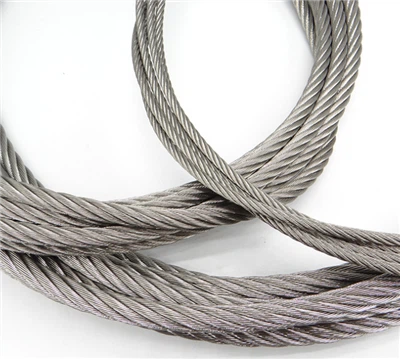
Here’s the thing: stainless steel wire rope isn’t a solid bar of metal. It’s a bundle of thin stainless steel wires twisted together, usually 7×7 or 7×19 construction (you’ve probably seen those numbers in our product listings). That twisting adds a layer of complexity that solid metal doesn’t have. The base stainless steel itself—like 304 or 316, the two most common grades we supply—has a Poisson’s ratio around 0.3 for the solid wire. But when you twist those wires into a rope, that number shifts a tiny bit. I’ve checked our technical specs a hundred times, and for standard stainless steel wire rope, the actual Poisson’s ratio you’ll see in real-world use is between 0.28 and 0.32. That’s a small range, but it’s enough to throw off calculations if you round it to 0.3 blindly.
Why does this range matter so much? Let’s say you’re using wire rope to suspend a 10,000 lb load on a crane. If your engineer calculates stretch using a Poisson’s ratio of 0.25 (way lower than the real number), they’ll guess the rope stretches more than it actually does. If they use 0.35 (higher than reality), they’ll miscalculate the stress on each wire, which could lead to premature wear. We’ve had a customer once who used a generic 0.3 number for a marine rig, and their initial stretch calculation was off by almost 12%—luckily, they caught it before installation, but that’s the kind of mistake that costs time and money.
Now, not all stainless steel wire rope is the same, so let’s talk about what changes that ratio. First, the grade of stainless steel. 304 vs 316: 316 has a small addition of molybdenum, which makes it more corrosion-resistant, but it barely shifts Poisson’s ratio—we’re talking a 0.01 difference at most. So for practical purposes, it doesn’t matter which marine grade you pick here. The bigger factor is the construction of the rope. 7×19 ropes have more individual wires than 7×7, so the twisting is tighter? Wait, no—actually, 7×19 is more flexible, with smaller wires. That extra flexibility means the wires can shift a tiny bit against each other when stretched, which tweaks the Poisson’s ratio a hair lower, around 0.29, compared to stiffer 7×7 which is closer to 0.31. We see this every day when we test new batches of rope for quality control—we measure stretch under load, calculate the ratio, and note that small shift for our customers.
Another thing that affects it is the load you put on the rope. Poisson’s ratio assumes elastic deformation, meaning the rope goes back to its original shape when you release the load. Once you hit plastic deformation (stretching past its yield point), the ratio changes entirely, and that’s not something you want to mess with anyway. So for all your design calculations, stick to that 0.28-0.32 range as long as you’re staying under the rope’s rated working load limit.
I get why some suppliers just give a flat 0.3 number and call it a day— it’s easy, and it works for most basic applications. But we’ve been supplying stainless steel wire rope for over a decade, and we’ve learned that the small details matter for people who rely on this stuff every day. A structural engineer building a bridge railing, a fisherman setting a heavy trawl, a garage door installer—all of them need that accurate number to make sure their rope lasts.
If you’re wondering why we don’t just list a single number on our product pages, it’s because there is no one-size-fits-all. The exact Poisson’s ratio is also affected by the diameter of the wire, the way the strands are laid, and even the tension the rope is under before use. For example, a 1/8 inch 7×7 stainless steel wire rope we ship for general utility will have a ratio at the higher end of our range, while a 5/16 inch 7×19 rope for sailboat rigging will sit a little lower.
Here’s a pro tip from our team: if you’re working on a critical project—like overhead lifting, structural support, or long-distance rigging—don’t just take a generic number. Reach out to our team, tell us exactly what you’re using the rope for, what grade and diameter you’re looking at, and we’ll pull the exact test data for that specific batch of rope. We test every shipment for tensile strength, stretch, and that Poisson’s ratio, so we can give you the precise number you need instead of a rough estimate.
We’ve had customers come to us after trying to use a generic ratio from a random website, and end up with their calculations off. Once, a customer was building a custom zip line and used a ratio from a 10-year-old physics blog that was 0.25—they thought the rope would stretch 2 feet, but it stretched 2.5 feet, which was enough to make the zip line drop too low in the middle. They fixed it by using our tested ratio, adjusted the tension, and it’s been running perfectly for two years now. That’s why we make it a point to share that nuance instead of just giving a number.
At the end of the day, stainless steel wire rope is a versatile material, but it’s not a perfect solid metal. The twist of the wires, the grade, the construction—all of these small things add up to a Poisson’s ratio that’s slightly different than a solid bar of 304 steel. For most everyday projects, 0.3 will work just fine, but if you’re pushing the limits, that 0.02 or 0.03 difference could be the thing that saves your project.
If you’re in the market for stainless steel wire rope, whether it’s for a small DIY job or a big commercial project, don’t hesitate to reach out to us. We’re not just here to sell you a spool of rope—we’re here to help you get the right product, with all the details you need to make sure your setup works exactly as it should. We’ve answered thousands of questions about wire rope specs, load limits, and yes, Poisson’s ratio, so we can help you navigate whatever you’re working on.
Wire Rope Clips References
- Callister, W.D. Jr. Materials Science and Engineering: An Introduction, 10th ed. John Wiley & Sons, 2018.
- ASTM A475 / A475M – 19, Standard Specification for Steel Wire, Plain, for Wire Rope. ASTM International, 2019.
- Stainless Steel Industry Association. “Stainless Steel Mechanical Properties Handbook,” 7th ed. 2021.
Nantong Solite Rope Co., Ltd.
As one of the most professional stainless steel wire rope manufacturers and suppliers in China, we’re featured by quality products and good price. Please rest assured to wholesale bulk stainless steel wire rope in stock here and get free sample from our factory. Customized orders are welcome.
Address: Xitong Industrial Park, Zhangzhishan Town, Nantong City, Jiangsu Province.
E-mail: suolitewirerope@gmail.com
WebSite: https://www.solidropeglobals.com/
